
DAD7606-C: A Three-in-One Architecture of Accuracy, Integration, and Reliability — Unlocking the Value of Synchronous Sampling DAS
Amid the continued advancement of Industry 4.0, the rapid evolution of new energy power systems, and the ongoing shift toward intelligent high-end manufacturing, Data Acquisition Systems (DAS) have become the foundational sensing layer of industrial intelligence. Their performance and reliability directly determine control accuracy, operational efficiency, and the quality of data-driven decision-making.
However, conventional data acquisition solutions exhibit clear limitations in several critical areas, which have increasingly become bottlenecks hindering industrial digital transformation.
To address these challenges, Beijing DSown Technology introduces the DAD7606-C, a breakthrough 16-bit, 8-channel simultaneous sampling data acquisition system. Built around the core principles of high accuracy, high integration, high reliability, and flexible configurability, the DAD7606-C leverages architectural innovation to overcome the constraints of traditional DAS designs, delivering a comprehensive system-level solution for modern industrial applications.
However, conventional data acquisition solutions exhibit clear limitations in several critical areas, which have increasingly become bottlenecks hindering industrial digital transformation.
To address these challenges, Beijing DSown Technology introduces the DAD7606-C, a breakthrough 16-bit, 8-channel simultaneous sampling data acquisition system. Built around the core principles of high accuracy, high integration, high reliability, and flexible configurability, the DAD7606-C leverages architectural innovation to overcome the constraints of traditional DAS designs, delivering a comprehensive system-level solution for modern industrial applications.

1. Synchronous Accuracy and Dynamic Performance
The DAD7606-C adopts a fully simultaneous sampling architecture, enabling all 8 channels to operate in strict synchronization at a sampling rate of 200 kSPS. Inter-channel timing skew is controlled at the nanosecond level, ensuring precise capture of time correlation across multiple signal paths.
It achieves a signal-to-noise ratio (SNR) of up to 94 dB, total harmonic distortion (THD) better than -106 dB, and integral and differential nonlinearity (INL/DNL) within ±0.5 LSB. These specifications make it well-suited for demanding industrial applications such as power quality analysis, motor drive control, and vibration monitoring, where high dynamic performance is essential.
The device integrates a second-order anti-aliasing filter with a 3 dB cutoff frequency of 45 kHz, effectively suppressing high-frequency noise aliasing. It also supports configurable oversampling from 2× to 32×. In oversampling mode, the SNR can be further improved to 96 dB, while the 3 dB bandwidth scales flexibly with the oversampling ratio. This allows users to optimize the trade-off between accuracy and real-time performance based on specific application requirements, making the device adaptable to a wide range of use cases—from high-precision measurement to high-speed control.
It achieves a signal-to-noise ratio (SNR) of up to 94 dB, total harmonic distortion (THD) better than -106 dB, and integral and differential nonlinearity (INL/DNL) within ±0.5 LSB. These specifications make it well-suited for demanding industrial applications such as power quality analysis, motor drive control, and vibration monitoring, where high dynamic performance is essential.
The device integrates a second-order anti-aliasing filter with a 3 dB cutoff frequency of 45 kHz, effectively suppressing high-frequency noise aliasing. It also supports configurable oversampling from 2× to 32×. In oversampling mode, the SNR can be further improved to 96 dB, while the 3 dB bandwidth scales flexibly with the oversampling ratio. This allows users to optimize the trade-off between accuracy and real-time performance based on specific application requirements, making the device adaptable to a wide range of use cases—from high-precision measurement to high-speed control.
2. Highly Integrated System Design
The DAD7606-C is built on a fully integrated design philosophy, incorporating key functional blocks such as analog input clamp protection, a second-order anti-aliasing filter, and a 2.5 V on-chip precision reference with buffer into a single device.
The analog inputs support ±16.5 V overvoltage protection, effectively safeguarding against transient surges commonly encountered in industrial environments. The integrated anti-aliasing filter (45 kHz, 3 dB cutoff) reduces high-frequency noise, while the on-chip 2.5 V reference features a low temperature drift of 10 ppm/°C, ensuring long-term accuracy and stability.
The device operates with a single 5 V analog supply (4.75 V to 5.25 V) and a logic supply ranging from 2.3 V to 5.25 V, eliminating the need for external amplifiers, bipolar power supplies, or standalone reference sources. This high level of integration reduces external component count by more than 30%, significantly lowering BOM cost and PCB footprint, while also shortening design and debugging cycles—particularly advantageous for space-constrained industrial control modules.
In addition, the DAD7606-C supports three interface modes: parallel, serial, and parallel byte. These can be flexibly configured via pins and are compatible with multiple interface standards, including SPI, QSPI, MICROWIRE, and DSP interfaces. It also supports switching between internal and external reference sources, facilitating multi-device daisy-chaining.
Without requiring hardware redesign, the device can be directly interfaced with mainstream processing platforms such as FPGA, DSP, and MCU, substantially reducing system integration effort and upgrade costs.
The analog inputs support ±16.5 V overvoltage protection, effectively safeguarding against transient surges commonly encountered in industrial environments. The integrated anti-aliasing filter (45 kHz, 3 dB cutoff) reduces high-frequency noise, while the on-chip 2.5 V reference features a low temperature drift of 10 ppm/°C, ensuring long-term accuracy and stability.
The device operates with a single 5 V analog supply (4.75 V to 5.25 V) and a logic supply ranging from 2.3 V to 5.25 V, eliminating the need for external amplifiers, bipolar power supplies, or standalone reference sources. This high level of integration reduces external component count by more than 30%, significantly lowering BOM cost and PCB footprint, while also shortening design and debugging cycles—particularly advantageous for space-constrained industrial control modules.
In addition, the DAD7606-C supports three interface modes: parallel, serial, and parallel byte. These can be flexibly configured via pins and are compatible with multiple interface standards, including SPI, QSPI, MICROWIRE, and DSP interfaces. It also supports switching between internal and external reference sources, facilitating multi-device daisy-chaining.
Without requiring hardware redesign, the device can be directly interfaced with mainstream processing platforms such as FPGA, DSP, and MCU, substantially reducing system integration effort and upgrade costs.
3. Industrial-Grade Reliability
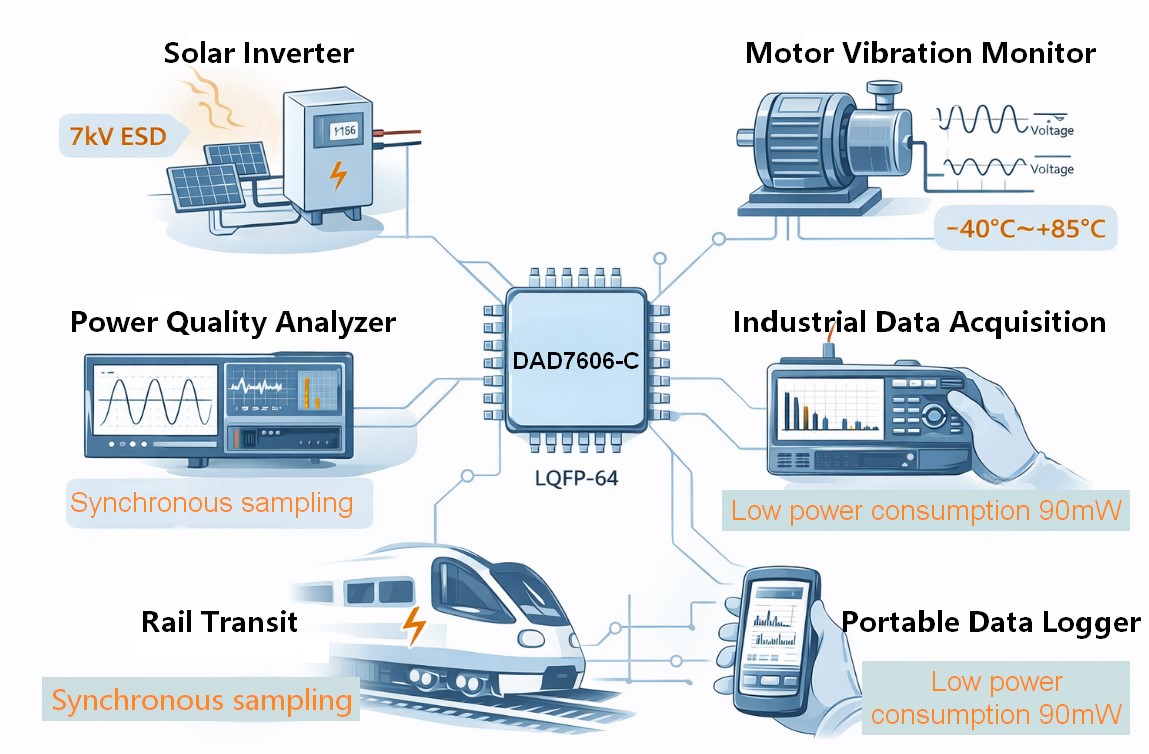
The DAD7606-C is specifically engineered for harsh industrial environments, with an operating temperature range of -40°C to +85°C. Its analog input channels feature ESD protection rated up to 7 kV, while maintaining a stable 1 MΩ input impedance independent of sampling frequency.
The integrated input clamp protection mechanism effectively withstands transient overvoltage events, ensuring continuous and reliable data acquisition under demanding operating conditions.
In photovoltaic inverter monitoring systems, the device can tolerate high temperatures and strong electromagnetic interference. In outdoor power line monitoring applications, it remains resilient against low temperatures and lightning-induced surge voltages, supporting long-term stable system operation.
This industrial-grade reliability makes the DAD7606-C highly suitable for mission-critical applications in power systems, railway transportation, industrial automation, and other environments requiring long-term operational stability under severe conditions.
4. Flexible System Compatibility
The DAD7606-C offers excellent system compatibility through support for three interface modes:
Interface modes can be flexibly selected through pin configuration, allowing seamless connection to FPGA, DSP, ARM, and other mainstream controller platforms without hardware redesign.
The device also supports both internal and external reference source selection, simplifying system-level synchronization in multi-device daisy-chain applications and reducing the complexity of multi-channel expansion.
Its wide logic supply range of 2.3 V to 5.25 V further enhances compatibility with different logic-level systems while minimizing the need for additional level-shifting circuitry.
This design philosophy enables the DAD7606-C to integrate smoothly into existing system architectures, significantly reducing the technical barriers and development costs associated with system upgrades and platform migration.
- Parallel Interface: Supports a 16-bit parallel data bus for high-speed data transfer
- Serial Interface: Compatible with standard SPI, QSPI, and MICROWIRE protocols
- Parallel Byte Interface: Provides an 8-bit parallel mode suitable for resource-constrained microcontrollers
Interface modes can be flexibly selected through pin configuration, allowing seamless connection to FPGA, DSP, ARM, and other mainstream controller platforms without hardware redesign.
The device also supports both internal and external reference source selection, simplifying system-level synchronization in multi-device daisy-chain applications and reducing the complexity of multi-channel expansion.
Its wide logic supply range of 2.3 V to 5.25 V further enhances compatibility with different logic-level systems while minimizing the need for additional level-shifting circuitry.
This design philosophy enables the DAD7606-C to integrate smoothly into existing system architectures, significantly reducing the technical barriers and development costs associated with system upgrades and platform migration.
5. Intelligent Power Management
The DAD7606-C adopts an advanced intelligent power management architecture, supporting flexible switching between multiple operating modes.
In normal operating mode, the device typically consumes 90 mW with all 8 channels enabled at a 200 kSPS sampling rate. In standby mode, power consumption can be reduced to as low as 35 mW while maintaining operation of the reference source and critical circuits.
In addition, each channel supports independent enable control, allowing users to configure the active channel count according to actual application requirements. This enables power-on-demand operation and further optimizes overall system power consumption.
For power-sensitive industrial applications such as renewable energy monitoring systems and portable test equipment, this intelligent power management strategy can significantly extend operating time, reduce thermal design requirements, and improve overall energy efficiency.
6. Typical Application Scenarios
- Renewable Energy Power Systems: photovoltaic inverters, energy storage converters, wind turbine pitch control systems
- Industrial Automation and Process Control: PLC/DCS systems, servo drives, robotic control systems
- Power System Protection and Monitoring: relay protection devices, power quality analyzers, smart meters
- Rail Transit and On-Board Systems: traction converters, vehicle power systems, train control units
- Test and Measurement Equipment: portable data acquisition instruments, industrial oscilloscopes, automated test systems
- High-End Manufacturing Equipment: CNC machine tools, industrial robots, semiconductor equipment
7. Core Value Proposition
The DAD7606-C delivers five core advantages for industrial data acquisition systems, helping customers build solutions that are more reliable, intelligent, and cost-effective.
A. Simplified Design and Faster Time-to-Market
Value:
A highly integrated single-chip architecture eliminates the need for complex external signal conditioning circuits, dual power supplies, and standalone reference sources.
Benefits:
Reduces external component count by more than 30%, lowering BOM cost and PCB footprint while shortening development and debugging cycles. This enables engineering teams to focus resources on core algorithm development and optimization, accelerating product launch timelines.
B. High Accuracy for Enhanced System Performance
Value:
Provides 16-bit resolution, precise simultaneous sampling, outstanding dynamic performance, and configurable oversampling capabilities.
Benefits:
Delivers high-fidelity raw data for applications such as power analysis, motor control, and vibration monitoring. This forms the foundation for precise control, advanced diagnostics, and intelligent decision-making, directly improving end-product performance and competitiveness.
Provides 16-bit resolution, precise simultaneous sampling, outstanding dynamic performance, and configurable oversampling capabilities.
Benefits:
Delivers high-fidelity raw data for applications such as power analysis, motor control, and vibration monitoring. This forms the foundation for precise control, advanced diagnostics, and intelligent decision-making, directly improving end-product performance and competitiveness.
C. Enhanced Reliability for Stable Operation
Value:
Features a wide operating temperature range (-40°C to +85°C), high ESD protection (7 kV HBM), overvoltage clamp protection, and consistently high input impedance.
Benefits:
Meets the demands of harsh industrial environments, significantly reducing failure rates caused by environmental stress factors such as temperature fluctuations, electrical interference, and transient events. This improves MTBF, reduces maintenance costs, and strengthens long-term product reliability.
Features a wide operating temperature range (-40°C to +85°C), high ESD protection (7 kV HBM), overvoltage clamp protection, and consistently high input impedance.
Benefits:
Meets the demands of harsh industrial environments, significantly reducing failure rates caused by environmental stress factors such as temperature fluctuations, electrical interference, and transient events. This improves MTBF, reduces maintenance costs, and strengthens long-term product reliability.
D. Maximum Flexibility with Lower Integration Cost
Value:
Supports multiple interface modes (parallel/serial), wide logic supply compatibility, selectable internal/external references, and compatibility with mainstream processor platforms.
Benefits:
Provides a one-stop integration solution, eliminating the need to redesign hardware for different platforms. This substantially reduces hardware modification cost and risk associated with system upgrades, platform migration, and multi-product development.
Supports multiple interface modes (parallel/serial), wide logic supply compatibility, selectable internal/external references, and compatibility with mainstream processor platforms.
Benefits:
Provides a one-stop integration solution, eliminating the need to redesign hardware for different platforms. This substantially reduces hardware modification cost and risk associated with system upgrades, platform migration, and multi-product development.
E. Intelligent Energy Efficiency Optimization
Value:
The DAD7606-C supports two power-down modes: standby mode and shutdown mode.
Benefits:
Particularly suitable for portable, battery-powered, or high-density installations, helping extend operating time, reduce thermal management requirements, and lower overall power consumption—supporting greener and more energy-efficient industrial system designs.
The DAD7606-C supports two power-down modes: standby mode and shutdown mode.
Benefits:
Particularly suitable for portable, battery-powered, or high-density installations, helping extend operating time, reduce thermal management requirements, and lower overall power consumption—supporting greener and more energy-efficient industrial system designs.
In summary, the DAD7606-C is more than just a high-performance ADC device—it is a complete system-level solution. Through architectural innovation, it combines high performance, industrial-grade reliability, ease of integration, and cost efficiency into a single platform. This enables customers to overcome data acquisition bottlenecks and build more powerful and dependable intelligent systems in the era of Industry 4.0 and smart manufacturing.
For more information, please visit DSown Technology or contact: